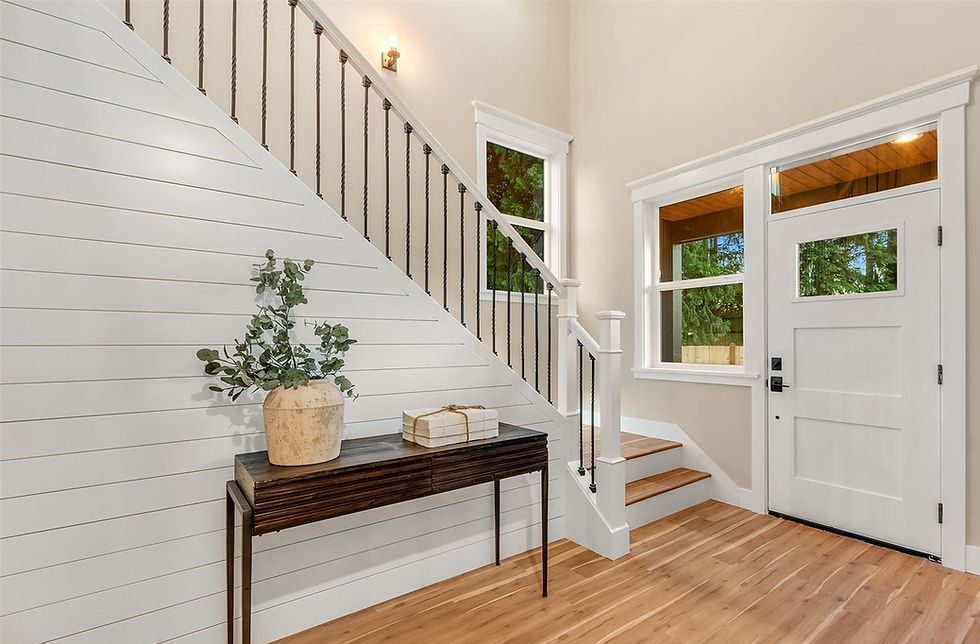
Home Staging Secrets - What Separates a Styled Room From a Pile of Nice Things

A seller fills a room with beautiful pieces before a showing, and it still looks amateur in the photos. The pieces are not the problem. The ratio between them is the problem.
There is a simple formula that quietly governs almost every professionally staged room. Once you know it exists, you understand why some listings look intentional and others, full of perfectly nice furniture, feel disconnected.

Staged by Genesis Home Staging & Design. Matthews Beach, Seattle, WA
What Is the 60/30/10 Rule in Home Staging?
The 60/30/10 rule is a color distribution formula that keeps a room balanced.
Sixty percent of a room is the main color, carried by the walls, the flooring, and the large furniture.
Thirty percent is the secondary color, found in things like curtains and accent chairs.
Ten percent is the accent, the pop of color in pillows, vases, and artwork. That balance is what gives a room cohesion without making it flat.
It sounds technical, but a buyer never sees the math. They only feel the result, a room that reads as calm and composed rather than chaotic.
Why Do Some Rooms Look Polished and Others Just Look Full?
A room looks polished when the eye has a clear hierarchy to follow: a dominant tone to rest in, a supporting tone for depth, and a small hit of accent for life. When those proportions are right, the room reads as deliberate. When they are off, with too many accents or competing dominant colors, the same furniture reads as busy and unplanned, no matter how nice each piece is on its own.
This is why a home full of expensive, beautiful things can still photograph poorly and sit on the market. Buyers do not register the individual pieces. They register whether the room feels settled, and balance is what creates that feeling.
Why Does a Staged Room Look Better Than One You Decorate Yourself?
A staged room looks better because it is built on proportion and restraint, not on adding more nice things. The instinct when preparing a home is to bring in more, more color, more accents, more personality. Professional staging works in the opposite direction, using formulae like 60/30/10 to make the room feel intentional to a buyer rather than full to a seller.
That judgment is the difference between a listing that photographs like every other home in the Seattle and King County market and one that stops the scroll. Genesis applies these formulas to every room so your listing reads as composed from the first photo a buyer sees.
What Is the Most Common Staging Mistake Sellers Make?
The most common mistake is too much accent. Sellers reach for color and pattern in every accessory, and the accent that should be ten percent of the room creeps to thirty, overwhelming the calm a buyer needs to relax and picture their life there.
The fix is restraint, pulling accents back until the dominant tone can breathe. A room with one confident accent almost always outperforms a room shouting in five. Knowing where that line sits, in your specific home, is exactly the kind of judgment a professional brings that a weekend of decorating cannot.
Genesis Home Staging styles homes across Seattle and King County using the formula that make a room read as intentional, so your listing competes on presentation, not just price. When your home is getting ready for market, reach out, and let us bring that balance to every room before your first showing.