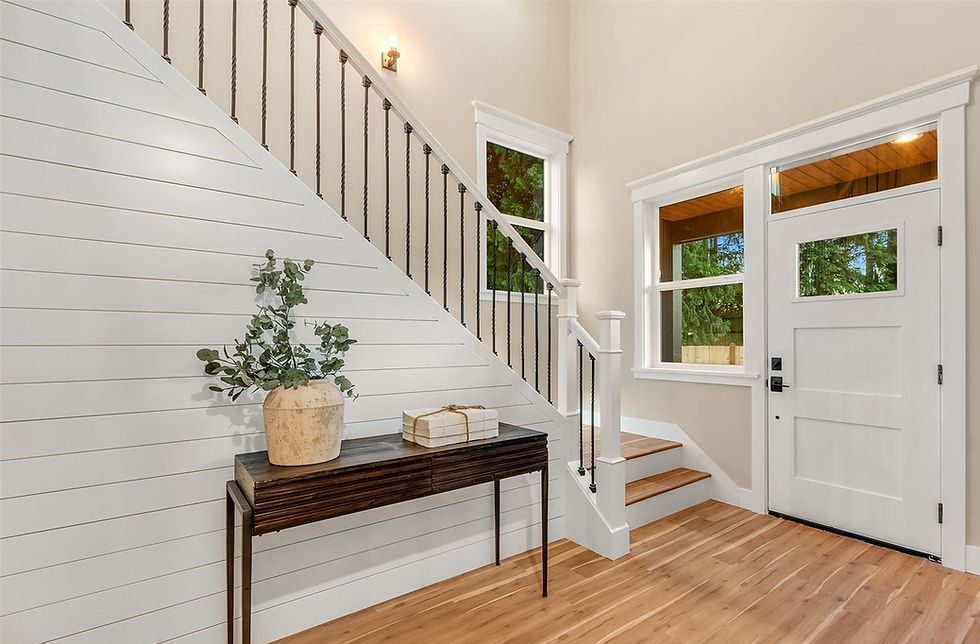
There Are Roughly 150,000 Shades of White. How Do You Find The Right Paint Color For Your Home?

You swear the trim is white. Then a stager holds a paint sample against it, and suddenly the wall looks pink.
It is not your imagination. It is the undertone.
White looks like the safest, simplest choice when preparing a home for sale. But white is rarely just white. With thousands of variations available, choosing the right one can be surprisingly complicated.
And the difference between the right white and the almost-right white can change how a room feels, photographs, and ultimately presents to buyers.

Why Is Choosing the Right White Paint So Hard?
Most whites are not completely neutral. They carry subtle undertones that can lean warm, cool, gray, green, pink, or yellow.
Those undertones can be difficult to see until the paint is surrounded by the rest of the room.
A white with a warm undertone might complement certain flooring beautifully but look yellow beside a cooler countertop. Another white might appear crisp and clean on its own but suddenly look pink against existing finishes.
So choosing white is not simply about finding a color you like.
It is about finding a color that works with everything already in the space.
What Makes White Paint Work in One Room and Fail in Another?
Start with the room, not the paint deck.
Look at the direction of the natural light. Then consider the flooring, cabinetry, countertops, trim, hardware, and existing furnishings.
And don't forget artificial lighting. The color temperature of your light bulbs can also influence how a white appears, particularly in the evening.
All of these elements influence how the eye perceives white.
This is why two rooms painted with the same color can feel completely different. One may feel bright and fresh while another feels flat or slightly dingy.
The goal when preparing a home for sale is not necessarily to make every room identical. It is to create a sense that the home works as a whole.
What About Existing Trim and Doors?
And don't forget what is already painted white.
Trim and doors are often overlooked because we think of them as neutral. But that existing white has an undertone too. Plus, paint ages overtime with exposure to the elements, dust, air, light etc.
When you place a new white wall color next to existing trim, the difference can suddenly become much more noticeable. The trim may look cream, yellow, gray, or even slightly pink depending on the new wall color beside it.
That is why you want to consider the existing trim and doors before choosing your wall color. You are not choosing a white for an empty room. You are choosing a white that has to work with everything that is staying in the room.
If the existing trim and doors are in good condition, a safe starting point is often to use the same paint color on the walls, trim, and doors, but in different finishes. For example, the walls can be painted in an eggshell finish while the trim and doors are painted in a semi gloss finish.
You get a subtle distinction between the surfaces without introducing another white with a competing undertone.
Same color, different finish.

Why Does Paint Look Different on the Wall Than on the Chip?
Because the paint chip is not the room.
A small sample viewed under store lighting cannot tell you exactly how a color will behave against your flooring at 10 a.m., beside your kitchen cabinets in the afternoon, or under the home's evening lighting.
And don't compare the sample only against the wall. Hold it next to the trim, doors, flooring, cabinets, countertops, and other finishes that will remain. The surrounding colors can change how that white appears.
Before committing to a color, it should be evaluated in the actual space and alongside the finishes that will remain.
This small step can prevent a much bigger problem later.
The last thing you want before listing is to discover that the “perfect” white needs to be repainted throughout the house.
Should You Choose Your Own Paint Colors Before Selling Your Seattle Home?
You certainly can.
But there is a reason professional eyes matter when preparing a home for sale.
When you live in a home every day, you become accustomed to its colors, lighting, furniture, and finishes. You may not notice that the flooring has a warm undertone or that a particular white is competing with the countertops.
Download our Top 10 Neutral Paint Colors For Home Staging
A professional looks at those relationships differently.
The question is not simply, “Do I like this white?”
It is:
“Does this white help this home look its best?”
That distinction matters when your goal is to create a home that feels clean, cohesive, and ready for its next owner.
Genesis Home Staging prepares homes across Seattle and King County with the entire visual picture in mind. Color is one part of that picture, and choosing it well can help every other element of the home work harder.
Before you pick up a paintbrush, make sure you are choosing the right white for the home, not simply a white you like.
When the goal is to prepare a home for market, the details matter. Genesis is here to help you get them right.